Thursday, 21 February 2013

Malaysia Chronicle

 
Malaysia Chronicle
BUT WILL NAJIB DO ANYTHING? Account for the humongous illicit outflows - Guan Eng tells PM
 
Finance Minister Datuk Seri Najib Tun Razak must fully account to 28 million Malaysians for the shocking RM 200 billion in dirty money siphoned out of Malaysia in 2010 and the scandal of RM 871 billon lost over the last 10 years or else admit the failure of his ETP. Najib’s stubborn silence and failure to act over this RM 871 billion scandal demonstrates not only his failure to uphold pubic accountability but that the BN government condones the practice of outflow of illict or dirty money.
Washington-based financial watchdog Global Financial Integrity (GFI), in its latest report which tracks capital flight, says the level of illicit flows from Malaysia in 2010 was the highest in 10 years. RM 197 billion of dirty money was siphoned out of Malaysia in 2010 compared to RM 93 billion in 2009, an increase of 112 %. Malaysia has the shameful record of being the No.2 country in the world after China, of illicit outflow of dirty money.
Figures are 'conservative' estimates
The GFI report, ‘Illicit Financial Flows From Developing Countries: 2001-2010', is co-authored by GFI economists Sarah Freitas and Dev Kar, who is a former senior economist at the International Monetary Fund. GFI has warned that capital flight in Malaysia is "at a scale seen in few Asian countries".
GFI described its estimates of global dirty money as "extremely conservative". Whilst Malaysia was ranked No. 2 globally in 2010, Malaysia is ranked No. 3 globally over 10 years from 2001-2010. The total 10-year estimate for Malaysia is US$285 billion (RM871.4 billion), while China is US$2,740 billion, and Mexico, US$476 billion.
GFI said that trade mispricing - the practice of shifting profits overseas by over- or under-invoicing intra-company transactions - accounts for an average of 80.1 percent of illicit financial flows from developing countries. The rest of the dirty money involves proceeds of corruption, bribery, theft, and kickbacks.
Where are the RESULTS of BNM probe
Despite Najib’s promises last year that a probe would be conducted by Bank Negara, Bank Negara has yet to announce the result of its investigations or explain the massive illicit capital flight, despite offers of help from top GFI economists. Is this another case of BN’s “Janji Tak Ditepati” of unfulfilled promnises?
The GFI report merely confirms the findings by the 2012 Transparency International report that Malaysia topped the Bribe Payer’s Survey in terms of lost business due to bribery. In this area, Malaysia ranked worst out of the 31 countries, worse than even Indonesia (47%), Pakistan (42%) and Russia (39%).Najib should come clean about this RM 871 billion scandal and wash away the shame it has brought to Malaysia by inviting top GFI economists who drafted the report to get to the root of this scandal.
Lim Guan Eng is the Penang Chief Minister & the DAP sec-gen
 

Wednesday, 20 February 2013

So is Dr M the world’s 2nd richest ex-leader with $ 44 BILLION?

So is Dr M the world’s 2nd richest ex-leader with $ 44 BILLION?

CASE OF THE MISSING NAME: So is Dr M the world's 2nd richest ex-leader with $ 44 BILLION?
Joe Fernandez
The oddest thing happened a day ago when former Malaysian prime minister Mahathir Mohamad’s name was mysteriously removed from a Wikipedia list detailing the wealth of former and current heads of state and government in the world.
Citing 53 references, the Wikipedia page had listed Mahathir as the second richest former head of government after deposed Egyptian President Hosni Mubarak whose wealth stands at somewhere between US$ 40 billion and US$ 70 billion.
However, while the Wikipedia page is still available in Malaysia, Mahathir’s name appears to have been mysteriously removed on Mon 17 Dec 2012 minutes after Malaysia Chronicle ran a story with the headlineMahathir now the world’s second richest ex-leader with US$ 44 BILLION?Alerted by a staff that Mahathir’s name had been replaced on the No. 2 spot by the late Indonesian president Suharto, the editors decided to withdraw the story pending further checks and granting that information on Wikipedia can sometimes be manipulated.
(Refer to the photographed version below of the page with Mahathir’s name clearly listed after Mubarak and compare it with the modified version as per the linkhttp://en.wikipedia.org/wiki/List_of_heads_of_state_and_government_by_net_worth.)
It must be noted the story was written in good faith and based on the Wikipedia allegation that Mahathir possessed a fortune of some US$ 44 billion. Obviously, if true, then there can only be bad implications for both Malaysia and Mahathir for how else could a prime minister elected by the people accumulate so much wealth without being involved in some way or other in corrupt activities.
Whether Mahathir really possesses such a staggering sum as US$44 billion – no one knows. And like his name oddly ‘disappearing’ from the Wikipedia list, the complex convolutions that need to be unraveled to reach the truth of how rich Mahathir and his family really are, will surely be beyond the efforts of even Hercule Poirot and Miss Marplecombined. Indeed, an army of international accountants, auditors, financial and banking specialists would be required, no less.

Extorted Taib and Jeffrey?
Even so, according to one of the references cited by Wikipedia, Mahathir’s modus operandi may be deduced by extrapolation and logical deduction from that adopted by Mubarak i.e. being in virtually every piece of business deal in the country thanks to guaranteed profits from monopolies, red tape fees, bribery fees, nepotism and whatnot. http://www.financetwitter.com/2011/02/marcos-mubarak-mahathir-whos-the-richest-man.html
Mahathir came to power in 1981, retiring only in 2003. The 1980s were a politically and economically turbulent decade for Malaysia as Mahathir struggled to stamp his control over his party, rivals and the government. Money always helps in any tussle. This is something that Mahathir, now 87, would have realized from early on.
Some political observers believe he may have launched himself on building up his personal war chest to finance his dynastic politics by first preying on Sabah strongman Jeffrey Kitingan and on Taib Mahmud of Sarawak. And to this day, Taib is accused of still ‘feeding’ Mahathir to stay in power as Putrajaya’s Chief Proxy in Borneo.
There’s no way that Taib could have stayed on as Chief Minister for so long in Sarawak and out of reach of the Malaysian Anti Corruption Commission (MACC) without him taking care of the powers-that-be in Putrajaya, the administrative capital of the federal government. Alternatively, those in Putrajaya are using Taib to bleed Sarawak dry.
It’s no secret that Mahathir has always detested Taib and tried to humiliate him upon becoming Prime Minister in 1981 by demoting him to the post of Federal Territory Minister allegedly to show his utter contempt for the man. There might have been some method in this madness. Mahathir’s loathing of Taib would have cost the latter plenty and more than usual. All the more reason to keep Sarawak on her knees and subservient to Putrajaya as a vassal state.
Jeffrey refused to part with even a sen to Mahathir before ISA
Taib “refused” or declined/neglected to take up his appointment as Federal Territory Minister and returned to Sarawak with his tail between his legs, upon Mahathir becoming Prime Minister, to take over from his uncle, Abdul Rahman Ya’kub, as Chief Minister.
By that time, the Sarawak United People’s Party (Supp) under Stephen Yong was threatening to leave BN unless the allegedly anti non-Muslim Rahman was removed as Chief Minister.
Jeffrey, as the political grapevine goes in Sabah where there are no secrets; refused to part with even a sen to Mahathir and the latter coincidentally had him incarcerated under the draconian Internal Security Act (ISA) for two two-year terms.
Jeffrey was accused by Mahathir of plotting to take Sabah out of Malaysia by force and establishing a Christian Republic with him as President.” Mahathir is widely believed in Sabah to have stage managed relieving Jeffrey of all his overseas accounts for his growing gravy train before letting him out just in time for the 1994 state election.
The fact is that Jeffrey, at one time, was wealthy behind comprehension and he doesn’t seem to have that kind of money anymore and coincidentally after his incarceration under the ISA.
Mahathir apologists claim that many of Jeffrey’s trusted aides and nominees also made off with millions kept under their names abroad, on business in Sabah and elsewhere. In one particular case, the figure reportedly totaled US$ 700 million kept in Australia.
These aides and nominees are no longer with Jeffrey but some of them, also doing business with the ruling party especially in the timber trade, are believed to be financing his politics “perhaps out of guilt for their past”.
Jeffrey’s jailing for ‘Christian republic’ a typical Dr M red herring to cover money fight?
It’s not known if and how much Mahathir and/or the state could have taken (or ‘fined’) from Jeffrey officially and unofficially. But that doesn’t stop the talk from buzzing around the coffee shops in Sabah.
One clue comes from the US$ 4 billion figure cited by Mahathir from a Price Waterhouse Report on an audit done on the Sabah Foundation in the wake of the fall of the Parti Bersatu Sabah-led Sabah state government in 1994. The Report found the figure as a difference between the actual or higher spot price of timber and the lower longterm contract price.
Mahathir, probably to throw a red herring on him taking Jeffrey’s money, has piously implied that the money was there but went missing during the latter’s stewardship of the Sabah Foundation.
Jeffrey had responded since then, whenever the issue was raised, that Mahathir was telling tall tales. Timber, explained Jeffrey, could not be sold on a long term contract basis at spot prices. The more you buy, the cheaper you get and vice versa. Also, buying forward for delivery in the future was not the same as buying now. Credible or not, that’s been Jeffrey defense all this while.
Taib was ‘luckier’
However, the truth may lie somewhere between Mahathir’s spin and Jeffrey’s explanations. In any case, the Sabah opposition leader has never been charged with corruption of any sort.
But no one in Sabah will deny that Jeffrey was too wealthy for his own good at one time and was now reduced to living on his pension from the Sabah Foundation, Parliament and the state assembly. If he runs into shortfalls, and his former aides and nominees can’t cough up soon enough, he sells a land here, a property there or turns to his elder brother Joseph Pairin Kitingan, the Huguansiou – paramount chief – of Sabah.
If rumors are true, Mahathir would have milked as much if not more from Taib than from Jeffrey for his gravy train. But the former Prime Minister obviously ensured that the Sarawak leader still stayed fabulously wealthy to secure Muslim domination of his Christian Dayak-majority state.
In Jeffrey’s case, Mahathir may have wanted him not only broke, but down and out, so that the Orang Asal as Christians would not have the finances to strike out politically on their own and challenge Putrajaya’s determination to marginalize and disenfranchise them through systematic racism, prejudice and opportunism as evident in internal colonisation policies.
US$ 100 billion went missing during Dr M’s premiership
Jeffrey and Taib may have been just the starters for Mahathir, with the main course consumed throughout the latter’s 22-year tenure as PM.
As Barry Wain’s book, Malaysian Maverick: Mahathir Mohamad in Turbulent Times,shows – at least US$ 100 billion went missing during Mahathir’s time as Prime Minister from 1981 to 2003.
Much of these missing monies may be the difference between the actual cost of government procurements, contracts, tenders, permits, concessions, quotas, licences and the like and the amount that they eventually cost the tax payers i.e. double, triple or even up to ten times the actual amount.
More recently, the Automatic Enforcement System (AES) costing the Public Treasury ten times what it should be is a case in point.
Then, there’s the infamous case of Bank Negara ostensibly “losing” US$ 30 billion in the forex market during Mahathir’s premiership, “losing” various other sums on schemes like trying to take over the International Tin Market in London, untold sums on replacing the Chinese role in Malaysia with the Japanese under the notoriously racist Look East Policy and crippling the Public Treasury with the equally discriminative Buy British Last Policy. All these smack of a money trail under the guise of Mahathir’s notorious Malaysia Boleh (Malaysia Can) brand of “patriotism”.
Mahathir & Co, as former Finance Tengku Razaleigh Hamzah once told an audience in Australia not so long ago, was awarding government contracts to themselves. Razaleigh was then accused by the Mahathir administration of “betraying” the country by badmouthing it overseas. It’s seems Mahathir was Malaysia and Malaysia was Mahathir.
Mahathir could only have done what Razaleigh accused him of doing by taking government money for himself through a network of nominees, cronies, fat cats and the like. In that case, he would have been no different from Mubarak and the many other corrupt dictators in the 3rd World who bled their countries dry and saddled them with crippling National Debt Burdens during their tenure in power.
Catching the eye of the CIA?

It’s likely that between Wain’s tell-all book and the Wikipedia list, Mahathir may have resigned from the premiership in 2003 for fear that he would be made to account for his abuse of power and conflict of interest issues in office.
He has been accused of devising a way to leave office but still hold on to the reins of powers from the background to ensure that the long arm of the law never catches up.
The public perception is that the Umno Supreme Council is firmly in Mahathir’s pocket and eating out of his hands while Najib Razak plays at being Prime Minister. Everyone can still recall Mahathir’s long goodbye which he set in motion after shedding tears on national TV and wailing emotionally that he had “failed the Malays and failed to change their mindset”.
It may also be more than coincidence that Wikipedia has managed to compile a listing of Mahathir’s ill-gotten gains in time for the run-up to the 13th General Election. This appears to be the work of the Central Intelligence Agency (CIA) in the clearest indication yet from Washington that it wants Mahathir and the ruling Barisan Nasional (BN) out of the picture for good. This is the classic modus operandi of the US Government i.e. release damaging personal financial information to destroy the credibility of their targets designed for destruction.
Mahathir has so far from all accounts been careful enough to salt away his wealth in countries which are out of reach of the SWIFT and IBAN international banking tracking systems initiated and financed by the United States to track ill-gotten gains, money laundering and financing of global terrorism. Japan is believed to be among the countries where the former Prime Minister has a considerable number of his assets.
Mahathir has huge enough war chest to create a lot of trouble
The bottom line is that Mahathir, given his huge war chest, can continue to influence and dictate the politics of the Malay Nation in Malaysia i.e. the Malay-speaking communities drawn from the Bugis, Javanese, Minang, Acehnese and Indian Muslims in Peninsular Malaysia. He is reportedly financing Perkasa, an extremist fringe organization run by his puppet Ibrahim Ali and has attempted to meddle in the politics of Opposition Leader Anwar Ibrahim’s Parti Keadilan Rakyat as well as Islamic party, PAS.
Already, Mahathir is in control of the huge funds at the disposal of Petronas mostly from Sabah and Sarawak. He has been accused of failing to make a distinction between Petronas funds and his money, at least in the amount poured into his Perdana Leadership Foundation, and he freely uses the corporate jets and yachts belonging to the oil corporation. He has been photographed on the yacht holidaying somewhere in the Mediterranean. Even the Agong, the Malaysian King, doesn’t get this privilege.
Mahathir also has the funds to poke into countries like Palestine and Bosnia-Herzegovina among other places through his Perdana Leadership Foundation – ostensibly to spread his hare-brained theories on leadership and vision-building — and has been suspected by Washington in the past of channeling money for arms to these places, among others. This is something where the Americans will draw the line.
 

Sunday, 17 February 2013

"The Inside Secret to Why Network Marketing will ALWAYS work!"


"The Inside Secret to Why Network Marketing will ALWAYS work!"


Some people believe that network marketing really doesn't
work. To put it lightly, they're WRONG. I am going to take
the next few minutes to explain to you why network marketing
will always work so that the next time someone takes the
time to tell you that network marketing doesn't work you
explain to them how misinformed they truly are.

Here is why Network Marketing will ALWAYS work:

Even in a strong economy people will ALWAYS need
supplemental income:

The truth is most people live pay check to pay check. They
aren't able to buy the nice things that they want for
themselves and their families. There is and will always be a
constant DEMAND for more money. Network marketing is a
simple, part time and low risk way for full time workers to
fill this need. To put it simply, as long as people need
money network marketing will ALWAYS be there to fill that
need.

People will ALWAYS want freedom from jobs they don't enjoy:

Despite what you may think, there are people out there that
truly don't enjoy their job. They go to work because they
have to and not because they want to. Network marketing
offers a promise of true financial freedom. The ability to
leave the 9 to 5 working world. This freedom will ALWAYS be
to tempting to pass up.

People will ALWAYS want more free time to do with as they
please:

Did you know in a past poll conducted by Money magazine that
64% of American men and 68% of American women polled said
that if they had a choice between more money and more time
off they would choose the time? People covet their free
time. Network marketing offers the promise of working from
home and making your own hours. Again, the opportunity to
create free time will ALWAYS draw people to network
marketing.

Conclusion:

As long as people crave time, money and freedom network
marketing will ALWAYS exist.

The next time that someone tries to tell you that network
marketing doesn't work you know that they couldn't be more
wrong.

All you have to is ask your accuser 1 of 3 questions:

Do you want more money?
Do you want freedom from your job?
Do you want more time?

I guarantee they will answer yes to one of these questions.
When they do they will have proved exactly why network
marketing will always work!

Resource Box:

Discover how to earn a whopping $17,022.85 per month in your
spare time even if nobody joins your MLM business. Forget
cold calling. Forget those home meetings. In fact, forget
everything you've ever been taught about building a solid
income in Network Marketing from the "gurus". Let this 24-
yr old "unknown" marketer show you how he built an organization
without making one phone call! ==> http://myonlinebusinessempire.com/business/referral.php?w=recruitonautopilot&p=danielkycool

Friday, 15 February 2013

Meteorite hits Russian Urals: Fireball explosion wreaks havoc, up to 500 injured (PHOTOS, VIDEO)


Russia’s Urals region has been rocked by a meteorite explosion in the stratosphere. The impact wave damaged several buildings, and blew out thousands of windows amid frigid winter weather. Hundreds are seeking medical attention for minor injuries.

­Follow RT's LIVE UPDATES.
Eyewitness accounts of the meteorite phenomenon, handpicked by RT.

According to unconfirmed reports, the meteorite was intercepted by an air defense unit at the Urzhumka settlement near Chelyabinsk. A missile salvo blew the meteorite to pieces at an altitude of 20 kilometers, local newspaper Znak reports quoting a source in the military.
Regnum news agency quoted a military source who claimed that the vapor condensation trail of the meteorite speaks to the fact that the meteorite was intercepted by air defenses.


A meteorite is a solid piece of debris from space objects such as asteroids or comets, ranging in size from tiny to gigantic.

When a meteorite falls on Earth, passing through the atmosphere causes it to heat up and emit a trail of light, forming a fireball known as a meteor, or shooting or falling star.

A bright flash was seen in the Chelyabinsk, Tyumen and Sverdlovsk regions, Russia’s Republic of Bashkiria and in northern Kazakhstan.
Up to 500 people sought medical attention as a result of the incident, according to the Russian Interior Ministry. No serious injuries have been reported, with most of the injuries caused by broken glass and minor concussions.
The Russian army has joined the rescue operation. Army units are searching for meteorite debris in several places, including an area near a military base next to Chebarkul Lake, west of Chelyabinsk. Another search area is 80 kilometers further to the northwest, near the town of Kusa.
Military units are also searching for possible debris in the neighboring Tyumen region.
Radiation, chemical and biological protection units have been put on high alert. Since the explosion occurred several kilometers above the Earth, a large ground area must be thoroughly checked for radiation and other threats.
At least one piece of the fallen object caused damage on the ground in Chelyabinsk. According to preliminary reports, it crashed into a wall near a zinc factory, disrupting the city's Internet and mobile service.
The Emergency Ministry reported that 20,000 rescue workers are operating in the region. Three aircraft were deployed to survey the area and locate other possible impact locations.
Witnesses said the explosion was so loud that it seemed like an earthquake and thunder had struck at the same time, and that there were huge trails of smoke across the sky. Others reported seeing burning objects fall to earth.
The Urals regional center of the Emergency Ministry claimed it sent out a mass SMS warning residents about a possible meteorite shower. However, eyewitnesses said they either never received it, or got the message after the explosion had already occurred.
Police in the Chelyabinsk region are reportedly on high alert, and have begun ‘Operation Fortress’ in order to protect vital infrastructure.
Office buildings in downtown Chelyabinsk are being evacuated. Injuries were reported at one of the city’s secondary schools, supposedly from smashed windows.
An emergency message published on the website of the Chelyabinsk regional authority urged residents to pick up their children from school and remain at home if possible.
Those in Chelyabinsk who had their windows smashed are scrambling to cover the openings with anything available – the temperature in the city is currently -6°C.
Chelyabinsk regional governor Mikhail Yurevich is urgently returning to the region. Yurevich said that preserving the city’s central heating system is authorities’ primary goal.
“Do not panic, this is an ordinary situation we can manage in a couple of days,” the governor said in and address to city residents.
Background radiation levels in Chelyabinsk remain unchanged, the Emergency Ministry reported.

Local zinc factory was damaged the severest, some of its walls collapsing
Screenshot from YouTube user Gregor Grimm


 The regional Emergency Ministry said the phenomenon was a meteorite shower, but locals ha
ve speculated that it was a military fighter jet crash or a missile explosion.
“According to preliminary data, the flashes seen over the Urals were caused by [a] meteorite shower," the Emergency Ministry told Itar-Tass news agency.
The ministry also said that no local power stations or civil aircraft were damaged by the meteorite shower, and that “all flights proceed according to schedule.”
Deputy Prime Minister Dmitry Rogozin, who also oversees the Russian defense industry, wrote on Twitter that he would speak with Prime Minister Dmitry Medvedev about the incident in the Urals.
“On Monday I will bring to Medvedev a straight picture of what has happened in the Urals and prospective proposals of how the country can find out about the dangers approaching Earth and deal with them,” Rogozin wrote.
Residents of the town of Emanzhilinsk, some 50 kilometers from Chelyabinsk, said they saw a flying object that suddenly burst into flames, broke apart and fell to earth, and that a black cloud had been seen hanging above the town. Witnesses in Chelyabinsk said the city’s air smells like gunpowder.
 

Screenshot from YouTube user Gregor Grimm

Residents across the Urals region were informed about the incident through a cellphone text message from the regional Emergency Ministry.
Many locals reported that the explosion rattled their houses and smashed windows.
“This explosion, my ears popped, windows were smashed… phone doesn’t work,”
Evgeniya Gabun wrote on Twitter.
“My window smashed, I am all shaking! Everybody says that a plane crashed,” Twitter user Katya Grechannikova reported.
“My windows were not smashed, but I first thought that my house is being dismantled, then I thought it was a UFO, and my eventual thought was an earthquake,” Bukreeva Olga wrote on Twitter.
The Mayak nuclear complex near the town of Ozersk was not affected by the incident, according to reports. Mayak, one of the world’s biggest nuclear facilities that used to house plutonium production reactors and a reprocessing plant, is located 72 kilometers northwest of Chelyabinsk.
It is believed that the incident may be connected to asteroid 2012 DA14, which measures 45 to 95 meters in diameter and will be passing by Earth tonight at around 19:25 GMT at the record close range of 27,000 kilometers.

Photo from Twitter.com user @varlamov

­


Another Tunguska event
The incident in Chelyabinsk bears a strong resemblance to the 1908 Tunguska event – an exceptionally powerful explosion in Siberia believed to have been caused by a fragment of a comet or meteor.

According to estimates, the energy of the Tunguska blast may have been as high as 50 megatons of TNT, equal to a nuclear explosion. Some 80 million trees were leveled over a 2,000-square-kilometer area. The Tunguska blast remains one of the most mysterious events in history, prompting a wide array of hypotheses on its cause, including a black hole passing through Earth and the wreck of an alien spacecraft.
It is believed that if the Tunguska event had happened 4 hours later, due to the rotation of the Earth it would have completely destroyed the city of Vyborg and significantly damaged St. Petersburg.
When a similar, though less powerful, unexplained explosion happened in Brazil in 1930, it was named the ‘Brazilian Tunguska.’ The Tunguska event also prompted debate and research into preventing or mitigating asteroid impacts.


Still from YouTube video/fed potapowStill from YouTube video/fed potapow

Still from YouTube video/fed potapow

Still from YouTube video/fed potapow

Photo from Twitter.com user @znak_com

Photo from Twitter.com user @Frolov_kgn Alexander

Map

Thursday, 14 February 2013

The Worst CEOs of 2012


Who are the absolute worst chief executives of 2012? Sydney Finkelstein thinks he knows. The longtime professor at Dartmouth College’s Tuck School of Business is the author of 11 books with such titles as Why Smart Executives Fail and Think Again: Why Good Leaders Make Bad Decisions, so he knows a thing or two about utter failure. He’s been putting out his list for three years now, and last year it included the chief executives of Netflix (NFLX), Research in Motion (RIM), and Hewlett-Packard (HPQ). Here’s the list (except where noted the companies didn’t respond to a request for comment):
1. Brian Dunn, who resigned as chief executive of Best Buy (BBY) in April after allegations surfaced that he had an inappropriate relationship with a much younger subordinate. That’s not why he’s on the list, though. Declining stock price, cratering same-store sales, loss of market share to more nimble competitors, and an addiction to share buybacks that cost the company $6.4 billion with little to show for it—that’s why he’s on the list.
2. Aubrey McClendon, the CEO of Chesapeake Energy (CHK) who apparently has trouble keeping his company’s finances and his own apart. According to Reuters, McClendon borrowed as much as $1.1 billion over three years in undisclosed loans against his stake in thousands of company wells and ran a $200 million oil-and-gas hedge fund on the side, an “obvious conflict of interest,” Finkelstein says. Use of the company jet (and company employees) for personal purposes and a corporate sponsorship deal for Oklahoma City Thunder while McClendon was an owner of the basketball team also didn’t help. Jim Gipson, a spokesman for Chesapeake Energy, declined to comment.
3. Andrea Jung, who stepped down as chief executive of Avon (AVP) in April but remains as chairman through the end of this year. Jung has been unable to fix the company’s operational problems, failed to groom a successor, and turned down a $10.7 billion offer from the beauty-care company Coty that, in retrospect, it should have leaped at. Since 2004, the company’s market value has fallen under her watch from $21 billion to $6 billion. And the company has had to spend $300 million in legal expenses related to allegations that it violated the Foreign Corrupt Practices Act, which bars bribery of foreign officials.
4. Mark Pincus, the CEO of Zynga (ZNGA), the mobile gaming company that brought the world Farmville, among other online distractions. Zynga stock is down 75 percent so far this year, and the company is losing top executive talent. Pincus has a fairly illustrious pedigree—he got a bachelor’s degree in economics from Wharton in 1988 and his MBA from Harvard Business School in 1993. But Finkelstein says he’s made some rookie mistakes, including hitching his company’s wagon much too securely to Facebook (FB), which Zynga relies on for a big chunk of revenue. And he hardly expressed confidence in the company’s prospects with his move to unload 16 million shares after the IPO lockup period ended. Joe Libonati, a spokesperson for Zynga, declined to comment.
5. Rodrigo Rato, who resigned as chairman of the Spanish lender Bankia (BKIA) in July. Rato is one of Spain’s former finance ministers and a former managing director of the IMF. He’s under investigation for fraud, price-fixing, and embezzlement in connection with Bankia’s spectacular collapse and bailout by the Spanish government. Rato has an MBA from the UC-Berkeley Haas School of Business. In 2011, Bankia announced profit of €309 million; after Rato resigned, it was restated to a €3 billion loss. Carmen de Miguel Hombria, a spokesperson for Bankia, declined to comment.
Two other executives—Mark Zuckerberg at Facebook and Andrew Mason at Groupon (GRPN)—almost made the list. The rap on Zuckerberg is his “massive ego,” while both men get demerits for immaturity and shares that move in only one direction, and not the right one. Says Finkelstein: “There’s no reason to believe they have the management skills to run a major public company.”
And don’t get him started on the hoodie.

Wednesday, 13 February 2013

Top 10 stock market tips for the uncertain year ahead

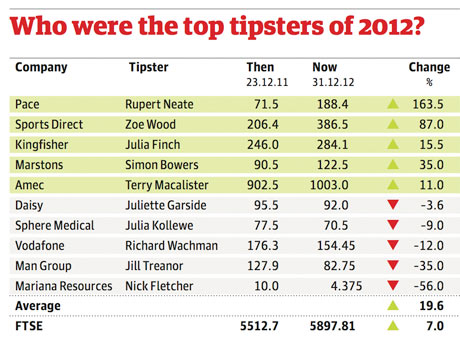
Crisis, what crisis? A late end-of-year surge on the stock market saw investors shrug off worries about the eurozone, a slowdown in China and – a late entrant on the fear index – the US budget impasse. That helped the FTSE 100 to rise 7% since the Guardian's 2012 tips were published.
Happily, our 10 choices did substantially better than the market, jumping by an average of 19.6%.
Pace, the set-top box maker, was the star performer, recovering from disruption caused by a shortage of hard disk drives the previous year. Despite a late wobble when it lost out on an auction to buy Motorola's set-top box business, it soared more than 160%.
Mike Ashley's Sports Direct International climbed 87% after seeing off struggling rival JJB Sports and benefiting from the London Olympics.
Other notable performances came from Marstons and Kingfisher.
There was of course a flop or two, notably Mariana Resources (mea culpa). The gold and silver miner has a supportive shareholder in AngloGold Ashanti, but that did not stop it losing more than half its value. Its Argentinian presence meant it was hit by worries about renationalisation, while there was disappointment at resource levels at its Las Calandrias project.
And so to 2013. The eurozone, the US fiscal cliff and the wider global economy are likely to dominate sentiment once more, so the uncertain atmosphere is likely to continue. With that in mind, we've picked 10 shares we hope will perform well despite market vicissitudes.

Julia Finch

Home Retail Group – Homebase and Argos – has had a rough ride in recent years with shares tumbling from more than 300p to Monday's 126.7p as a result of tough competition, poor sales of computer games and the squeeze facing its less well-off shoppers. It should gain in 2013 from any improvement in the economy and consumer sentiment and from its own three-year turnaround plan. Argos is also one of the UK's most webby retailers, getting 42% of sales online. But there is another factor in its favour this year: the demise of rival Comet, putting its £1bn of annual sales up for grabs. Some 75% of Home Retail's revenues come from Argos, and 51% of Argos revenues come from electricals. If Argos can grab some of Comet's 6% market share to add to its own existing 10% there should be benefits from sales volumes and margins.

Simon Bowers

Buying opportunities are emerging as US fiscal cliff talks go down to the wire. If you believe the underlying American economy is strengthening, and that the politicians will find a compromise in the national interest, there are plenty of London-listed stocks worth looking at. Drinks group Diageo has a strong exposure to the US market. Shares have had a good run in 2012, but have eased back a shade in recent weeks to £17.87. The company was frustrated in its efforts to take over tequila brand Jose Cuervo and may only play a marginal role, if any, in the bidding war for US rival Beam next year. That may be no bad thing for the share price. Diageo does have exposures to some of the toughest European economies, but its global reach ought to mean continuing difficulties here are absorbed. The acquisition of a majority stake in India's United Spirits group will complete next year. It is just the latest development in Diageo's push into the fast-developing Bric markets.

Simon Goodley

Betfair chronically mis-priced its 2010 flotation when the betting exchange managed to persuade enough mugs to take a punt at £13 a share. They are just over half that level now, at 686.5p, but despite there being few signs of life in the shares, the company has at least started to acknowledge previous mistakes. New chief executive Breon Corcoran, who was poached from rival Paddy Power, has started in a pragmatic mood, withdrawing from costly foreign adventures such as in Germany, where the company is struggling to foresee a future regulatory and tax regime that will allow it to make a profit. He's also retreated from vanity projects such as the company's financial betting exchange, LMAX. As both of these areas were once used to justify the Betfair float price, critics might argue that the moves make the company look unambitious. But industry insiders reckon that Corcoran has plenty of early easy wins to focus on, principally by cutting Betfair's cost base to swiftly increase profits. After more than two years as a public company, this might finally be the time to bet on Betfair.

Jill Treanor

2012 was not a good year to have tipped Man Group, the world's biggest listed hedge fund group, which relies on its "black box" AHL flagship fund for its performance. AHL, which uses computers to spot trends in markets, has been blown off course by quantitative easing and Man's shares had fallen almost 80% since the start of 2011. Yet as 2012 drew to a close, the shares started to perk up after chief executive Peter Clarke was shown the door. Installing Manny Roman, who arrived with the acquisition of hedge fund GLC, has given investors fresh hope, while new finance director Jonathan Sorrell – son of WPP boss Sir Martin Sorrell – is expected to start cutting costs. With a bit of luck, the shares – now 82.75p – will recoup their 2012 losses during 2013.

Nick Fletcher

Issuing a profit warning in the middle of a takeover situation is not ideal, and defence group Chemring duly suffered the consequences. Its share price collapsed, losing almost half its value over 2012, but even the prospect of a bargain-basement price was not enough to tempt potential bidder Carlyle Group to take the plunge. Chemring replaced its chief executive, and the new man, Mark Papworth, who did well at oil services business Wood Group, will outline his strategy in January. Defence spending in the UK and US is likely to remain under pressure but Chemring now has a platform for recovery. Some excitable souls even believe another bid could eventually emerge, if not from Carlyle then from another private equity group. A speculative bet at 229.6p on Papworth turning things round.
Top tipsters of 2012

Nils Pratley

Think of this – Ruffer Investment Company – as an anti share tip. It is chosen to provide protection in the rainy investment weather that 2013 may bring. Jonathan Ruffer has positioned the investment trust for a tipping point, the moment when central banks' huge injections of newly created money make themselves felt. He is far from being a hyper-inflation nutter; he's just making the reasonable point that investors need to watch their backs in an era when the US Federal Reserve is openly pursuing reflation to create jobs. The fund, currently at 199.25p, is flush with index-linked government debt, gold and Japanese equities. It ain't glamorous. But, one day, those assets could be the right place to be. Is that year 2013? Ruffer is often too early in his calls, so who knows? But surely you don't expect guaranteed winners from newspapers' share tips.

Terry Macalister

Some online companies are in the sin bin over tax issues but Asos, with its logistics base at Barnsley in the white rose county of Yorkshire, continues to smell sweetly. The net-based fashion retailer was also heading for a "stonking Christmas," according to its chief executive and founder, Nick Robertson, and there are reasons to believe its already highly valued shares, £26.91, should still find more uplift next year, too. New international sales helped drive up profits 40% in the 12 months to 31 August, and there are high hopes for a forthcoming move into the Chinese and Russian youth markets.

Simon Neville

When SSE – Scottish and Southern Energy as was – announced a 38% boost in half-year profits in November while simultaneously raising gas and electricity prices, people were quite rightly fuming. So if you can't beat them, why not join them? 2013 for SSE is likely to see more of the same – profits continuing to rise. Throw in a dividend yield of more than 6% and you're unlikely to find a better return on such a safe investment. Confusion on Britain's energy future remains, depressing SSE's share price a little, so as we inch each day closer towards the government being forced into making a decision over the country's needs, expect a nice boost to the current £14.18. And with outspoken chief executive Ian Marchant at the helm, SSE has the best chance of getting its own way.

Juliette Garside

TalkTalk shares are up 70% to 233.6p since January, but chief executive Dido Harding (pictured below), is only just getting going: the rollout of TalkTalk's budget pay TV service, along with fibre broadband and mobile phone deals, began in earnest in November. The model has worked well for Virgin Media and BSkyB: increase profits by selling more services to your existing customers. But TalkTalk should be able to grow headcount by tapping into Freeview's 10m users. Some of the potential is already priced in, but Goldman Sachs has a 290p target by November next year, underpinned by healthy dividend growth.

Rupert Neate

When one of the world's best-known activist investors declares he's made it his "patriotic" duty to destroy a company, there's probably something in it. The market certainly reckons Bill Ackman's on to something with his $20m bet against slimming powder and body-building supplement company Herbalife – the shares fell 38% last week when Ackman revealed his short position and accused the company of being "the best-managed pyramid scheme in the history of the world". Ackman, founder and chief executive of hedge fund Pershing Square Capital Management, told investors he was more committed to bringing down Herbalife "than any investment I have ever made, full stop". Herbalife denies all the accusations. Although shares have already fallen to $29.39, Ackman says: "Our target price is zero, because we think the business will fail." If you can get your hands on any to short (it might be quite tricky; Ackman's shorting as many as he can), you might profit from Herbalife's decline. Ackman's committed to giving all profits to charity (you don't have to).
 
CLICK HERE FOR US STOCKS EXPERT
 

Friday, 8 February 2013

Asian Stocks Decline, Paring Weekly Gain as Sony Tumbles

Asian Stocks Decline, Paring Weekly Gain as Sony Tumbles


Goldman’s Cohn ‘Bullish’ on China After ICBC SaleAsian stocks fell, paring this week’s advance, after Sony Corp. posted an unexpected loss and the European Central Bank said the euro’s strength could hamper an economic recovery, damping the profit outlook for exporters.

Sony tumbled 10 percent after posting an eighth-straight quarterly loss and cutting sales targets for TVs, gaming devices and cameras. GS Engineering & Construction Corp. lost 7 percent in Seoul, among the biggest declines on the Asian benchmark, after reporting a fourth-quarter loss. Fujitsu Ltd., a Japanese maker of computers, network equipment and mobile phones, gained 5.1 percent after saying it will eliminate 5,000 jobs and merge its LSI chip business with Panasonic Corp.
 

Feb. 6 (Bloomberg) -- Gary Cohn, president of Goldman Sachs Group Inc., talks about the outlook for China and Goldman's sale of a $1 billion stake in Industrial & Commercial Bank of China Ltd. last week. Cohn, speaking with Bloomberg Television’s Susan Li in Hong Kong yesterday, also discusses Goldman's strategy, financial markets and Europe's debt crisis.
About four stocks fell for every three that gained on the MSCI Asia Pacific Index, which fell 0.2 percent to 132.96 as of 6:14 p.m. in Tokyo. The gauge is headed for a 0.2 percent gain for the week.
“We certainly expect to see these shivers and worries from Europe,” said E. William Stone, who helps oversee $112 billion as chief investment strategist at PNC Wealth Management.“You’re probably wise to be a little less aggressive at the current time just because we’ve had quite a run without much of a pullback. Hence our recommendation to be a little more on the defensive side.” Stone was speaking in a Bloomberg Television interview with Zeb Eckert.
Japan’s Nikkei 225 Stock Average fell 1.8 percent to finish the week down 0.3 percent, the first drop after 12 consecutive weeks of gains through Feb. 1, the longest such winning streak since 1959, according to Nikkei Inc. Australia’s S&P/ASX 200 Index climbed 0.7 percent today and South Korea’s Kospi Index added 1 percent. Hong Kong’s Hang Seng Index rose 0.2 percent and China’s Shanghai Composite Index advanced 0.6 percent.

Relative Value

The MSCI Asia Pacific Index, the benchmark regional equities gauge, rallied 13 percent in the seven months through yesterday. That left the gauge trading at 14.8 times average estimated earnings compared with 13.6 for the Standard & Poor’s 500 Index and a multiple of 12.2 for the Stoxx Europe 600 Index, according to data compiled by Bloomberg.


Sony lost 10 percent to 1,365 yen to lead declines on the Asia-Pacific gauge. Japan’s biggest consumer-electronics exporter cut its sales forecast for portable game players in the year ending March to 7 million units from the 10 million predicted three months ago and the 16 million forecast in May. Its TV sales outlook was pared to 13.5 million units from a projection of 17.5 million made in May.
GS Engineering slumped 7 percent to 51,800 won. The firm posted a 75.7 billion won ($69 million) loss for the fourth-quarter, below 55.2 billion won net-income forecast by analysts in a Bloomberg survey.

Fujitsu, Panasonic

Fujitsu advanced 5.1 percent to 434 yen. The venture with Panasonic will design large-scale integration, or LSI chips, and contract out their manufacture, according to a joint statement yesterday. The state-backed Development Bank of Japan has been asked to help finance the venture, the companies said.
Newcrest Mining Ltd. rose 5 percent to A$24.52 as Australia’s largest gold producer reported first-half profit that was 9.6 percent higher than estimates, saying output would increase this half.
Of the 275 firms on the MSCI Asia Pacific index that have reported earnings so far this quarter and for which Bloomberg has estimates, 52 percent have exceeded profit expectations. Some 53 percent have missed sales projections, the data compiled by Bloomberg show.
Hong Kong’s market will be shut three days next week for the Chinese New Year holidays, while mainland markets will be closed all week.

China Exports

China’s exports and imports rose more than estimated in a January that had five more working days than last year, helping sustain a growth rebound in the world’s second-biggest economy.
European Central Bank President Mario Draghi told reporters growth risk continues to be on the “downside,” accommodative ECB policy will support the economy and the recent strength of the euro create may damp inflation. An economic recovery should begin later this year as an absence of inflation risks allows the ECB to maintain record-low interest rates, he said yesterday.
Futures on the Standard & Poor’s 500 Index were little changed. The gauge slid 0.2 percent yesterday. The S&P 500 has rallied almost 6 percent in 2013 as U.S. lawmakers reached a budget compromise and companies reported better-than-estimated earnings. The benchmark U.S. equity gauge is about 3.7 percent below its record high reached in October 2007 after more than doubling since bottoming in March 2009.
The Reserve Bank of Australia today reduced its economic growth and inflation forecasts as investment outside the mining industry remains elusive, the labor market softens and a high local currency contains prices.
Chorus Ltd., New Zealand’s biggest telephone network operator, rose 10 percent to NZ$3.15 in Wellington, the most on record, after the government delayed proposed cuts to its wholesale Internet pricing pending a review of industry regulation.

Thursday, 7 February 2013

Eight Dead in Solomon Islands After Quake, Agency Says

Eight Dead in Solomon Islands After Quake, Agency Says


Eight people were killed when a tsunami triggered by a magnitude 8.0 off-shore earthquake hit the Solomon Islands yesterday, according to the aid organizationWorld Vision.
More than 70 aftershocks, including a magnitude 7.0 quake, followed the main temblor which struck yesterday at 12:12 p.m. local time, 81 kilometers (50 miles) west of Lata, at a depth of 5.8 kilometers, according to the U.S. Geological Survey.
There’s still “a little bit of nervousness,” among the 4,000 residents of Lata, some of whom spent the night in the hills, or in emergency shelters set up at a school and a local church, Andrew Catford, World Vision’s country coordinator in the Solomon Islands, said in a phone interview today from the capital, Honiara. The organization has 20 people in Lata.
“Is this a lead up to something else?” is the main concern of the residents, he said.
The airport at Lata, the provincial capital, remained closed today after being flooded, preventing aid organizations from bringing in supplies. There is currently no running water and no power in Lata, Catford said.
“We hope to reach some of the most remote communities by boat,” he said.
A wave measuring 91 centimeters (3 feet) in height was recorded at Lata Wharf, near the epicenter, and an 11-centimeter wave was recorded in Luganville, Vanuatu, the Pacific Tsunami Warning Center reported yesterday. Tsunami warnings for several nations in the region, including Nauru, Fiji and New Caledonia were later canceled.

Homes Destroyed


The sea surge destroyed, or severely damaged, more than 100 homes, according to World Vision. Government and aid officials haven’t been able to contact people on low-lying, heavily populated, atolls that may have been in the path of the tsunami, Catford said.
The surge also washed up deep-sea fish and killed livestock on shore and the area needs to be cleaned up for health reasons, Catford said.
The Solomon Islands archipelago, about 2,500 kilometers east of Australia, lies in the Pacific “Ring of Fire” and experiences frequent seismic tremors. About 50 people were killed and more than 5,000 left homeless there after an 8.1-magnitude earthquake triggered a tsunami in April 2007.